Lincoln County Dog Registration Information
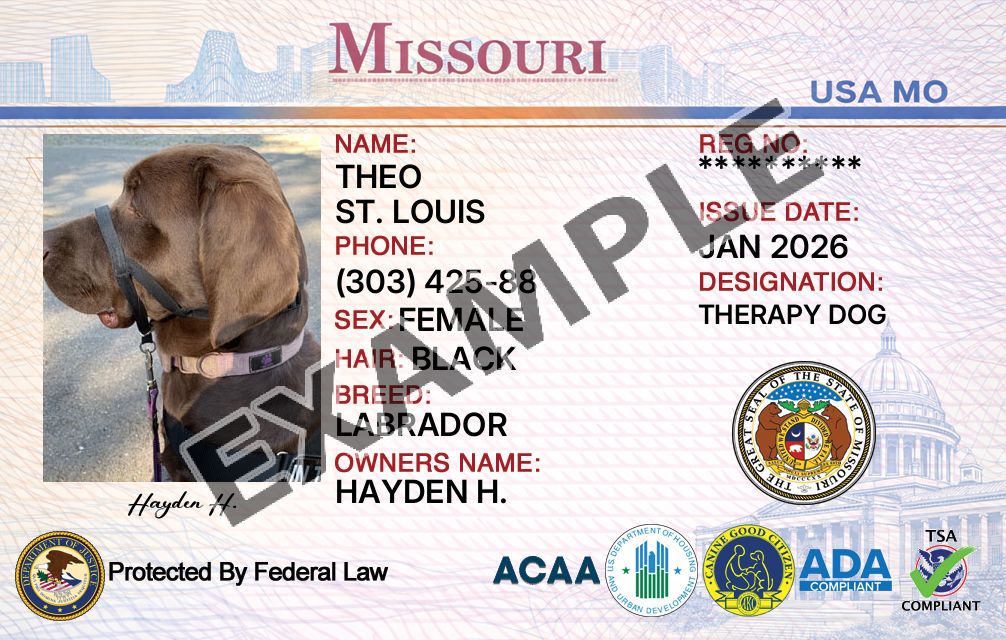
Service Dogs and Emotional Support Animals in Lincoln, Missouri
If you’re asking, “where do I register my dog in Lincoln County, Missouri for my service dog or emotional support dog”, the key thing to know is that dog licensing is typically handled locally (often by a city clerk or municipal office) and is separate from whether your dog qualifies as a service dog or an emotional support animal.
This page explains how to get a dog license in Lincoln County, Missouri, where to contact local offices, what rabies records you’ll usually need, and how licensing differs from the legal rules for service animals and ESAs.
Where to Register or License Your Dog in Lincoln County, Missouri
Because licensing is often handled at the city level in Missouri, where to register a dog in Lincoln County, Missouri can depend on whether you live inside city limits (such as Troy, Moscow Mills, or Winfield) or in an unincorporated area of the county. The offices below are examples of official local government contacts within Lincoln County.
Example official offices (within Lincoln County)
| Office | Address | Phone | Hours | |
|---|---|---|---|---|
| Troy City Hall (City Clerk / Dog Tag Registration) |
800 Cap Au Gris St. Troy, MO 63379 |
636-528-4712 | Not listed | Mon–Fri 8:00 a.m.–4:30 p.m. |
| Moscow Mills City Hall (City Clerk) |
500 Hwy MM Moscow Mills, MO 63362 |
636-356-4220 | Not listed | Mon–Fri 8:00 a.m.–4:30 p.m. |
| Winfield City Hall |
51 Harry’s Way Winfield, MO 63389 |
636-668-8100 | info@winfieldmo.gov |
Mon, Tue, Thu, Fri 8:00 a.m.–5:00 p.m. (closed 12–1) Wed closed |
| Lincoln County Health Department (Rabies / bite reporting information) |
5 Health Department Drive Troy, MO 63379 |
636-528-6117 | Not listed | Not listed |
If you are unsure which office applies to you, start with your city hall (if you live in a municipality) and ask whether your address is within city limits and whether they issue local pet licenses. For unincorporated areas, ask the county or the health department who administers rabies enforcement or licensing where you live.
Overview of Dog Licensing in Lincoln County, Missouri
What a dog license is (and what it is not)
A dog license in Lincoln County, Missouri generally refers to a local registration/tag issued by a municipality. The license is commonly tied to:
- Rabies vaccination compliance (proof is commonly required to obtain or renew a license)
- Identification (a tag number that can help reunite you with your dog if it’s found)
- Local enforcement of animal rules (running at large, nuisance, bite/quarantine procedures, and similar ordinances)
A dog license is not the same as “service dog registration” or “ESA registration.” Even if your dog is a service animal or emotional support animal, you may still need to meet local licensing and rabies rules that apply to all dogs in your area.
Who enforces rabies and animal rules in the county
Lincoln County residents should be aware that not all counties operate a countywide animal control authority. Some animal-related enforcement and services can be handled by the municipality (within city limits), while other aspects—like bite reporting and public health guidance—may involve the Lincoln County Health Department. This is why many residents searching for an animal control dog license Lincoln County, Missouri end up being directed to a city hall or city department rather than a single county licensing office.
Rabies vaccination expectations
In many Missouri cities, proof of a current rabies vaccination is required when applying for or renewing a local dog tag/license. Your proof usually comes from your veterinarian (certificate or receipt showing vaccine date and expiration). If your dog’s rabies vaccination is expired, you may need to update it before the local office can issue a license.
How Dog Licensing Works Locally in Lincoln County, Missouri
Step 1: Confirm your jurisdiction (city limits vs. unincorporated county)
The first step in figuring out where to register a dog in Lincoln County, Missouri is confirming whether you live:
- Inside a city (for example, Troy, Moscow Mills, or Winfield), where licensing may be handled by the city clerk/city hall, or
- Outside city limits in an unincorporated area, where there may be different processes (and fewer centralized animal services)
If you provide your city (or nearest town) and whether you are inside city limits, local staff can usually point you to the correct licensing process quickly.
Step 2: Gather your documents
Most local licensing processes are straightforward. Commonly requested items include:
- Rabies vaccination proof (certificate from a veterinarian)
- Owner identification (such as a driver’s license or other ID)
- Proof of residency (especially if licensing fees differ for residents vs. nonresidents)
- Payment for the licensing fee (fees can vary by city and may differ based on spay/neuter status)
Step 3: Apply and receive a tag (or certificate)
Depending on the municipality, you may apply in person at city hall, submit a form, or use a local process for renewals. Once approved, you typically receive:
- A license tag (to attach to your dog’s collar), and/or
- A registration certificate for your records
Keeping the tag visible on your dog’s collar helps if your dog gets loose and also demonstrates compliance if local officers check licensing.
What if your dog is a service dog or an emotional support animal?
Your dog may be a service animal or ESA and still be expected to follow generally applicable requirements like rabies vaccination and local licensing. The key difference is that licensing is about local animal regulation, while service dog legal status is about disability rights and access. The sections below break down the difference clearly.
Service Dog Laws in Lincoln County, Missouri
Service dogs are defined by training and disability-related work
A service dog is generally a dog that is individually trained to do work or perform tasks for a person with a disability. The focus is on trained tasks (for example, guiding, alerting, retrieving items, interrupting harmful behaviors, or other disability-related assistance).
Importantly, service dogs are not made “official” by buying a vest, an ID card, or signing up for a website. If you are searching for “registration,” what you usually need in practice is:
- Compliance with local animal rules (rabies vaccination and any required local license/tag)
- A dog that is trained for disability-related tasks
Public access: what businesses may ask
In many public settings, staff may be limited in what they can ask. In general practice, they may ask questions aimed at confirming the dog is a service animal (not a pet), but they should not require a “registration certificate” from the internet as proof. A local dog license tag is not the same thing as proof of service dog status, and a service dog is not required to be “county registered” as a service animal just to exist as a service dog.
Licensing still matters
Even though service dog status is about training and disability-related work, a service dog owner should still expect to follow neutral public health rules like rabies vaccination and any applicable local licensing requirements. If you’re asked for a dog license in Lincoln County, Missouri, that typically means the city/county wants proof your dog is vaccinated and properly licensed—not that they are questioning whether your dog is a legitimate service animal.
Emotional Support Animal Rules in Lincoln County, Missouri
ESAs are not the same as service dogs
An emotional support animal (ESA) provides comfort by its presence, but is not necessarily trained to perform specific disability-related tasks. This distinction matters because ESAs generally do not have the same public access rights as service dogs in places like restaurants, grocery stores, or other general public settings.
Housing and documentation basics
ESA situations most commonly arise in housing. A landlord or housing provider may have a process to request documentation supporting the need for an assistance animal. That housing process is separate from local licensing. Even if your housing provider recognizes an ESA, your dog may still need to meet local animal requirements like rabies vaccination and a local license/tag.
Avoid “ESA registration” misunderstandings
If you’re trying to figure out where to register a dog in Lincoln County, Missouri for an ESA, what you typically need is:
- Your local dog license (if your city requires it), and
- Any housing-related documentation your housing provider requests through their reasonable accommodation process
A local dog license is a routine local compliance step. It does not “make” the dog an ESA, and it does not grant public access rights.
Frequently Asked Questions
Do I need a dog license if my dog is a service dog?
Often, yes. A service dog may still be subject to generally applicable rules like rabies vaccination and any local licensing/tag requirements. If your municipality requires a dog tag, your service dog is usually expected to comply just like any other dog.
Is there one countywide office for an animal control dog license in Lincoln County, Missouri?
Not always. Some services are handled by municipalities within their city limits. That’s why many people searching for an animal control dog license Lincoln County, Missouri are directed to city hall (or a city department) rather than a single county animal control building.
What proof do I need to license my dog?
A common requirement is proof of a current rabies vaccination. You may also be asked for identification, proof of residency, and payment of the licensing fee. Requirements vary by municipality, so confirm with your local office.
Does a dog license prove my dog is a service animal or an ESA?
No. A dog license primarily shows local compliance (often tied to rabies vaccination and local ordinances). Service dog status is based on training and disability-related work/tasks. Emotional support animal status is typically handled through housing-related processes and documentation, not through local licensing.
What if I live outside city limits?
Start by contacting the nearest municipality where you receive services or by contacting the Lincoln County Health Department for guidance on rabies-related procedures and who to contact locally. For bites or rabies concerns, public health guidance and reporting processes may differ from city licensing.
What You May Need
- rabies vaccination proof
- identification
- proof of residency
- licensing fee
Quick tip for faster answers
When you call, ask: “Do you issue dog tags for my address, and what do you require for renewal?” That helps the office quickly determine whether you are in city limits and which process applies for a local dog license in Lincoln County, Missouri.
Register A Dog In Other Missouri Counties
Select your county below to get started with your dog’s ID card. Requirements and license designs may vary by county, so choose your location to see the correct options and complete your pup’s registration.
- Adair County Dog Registration
- Andrew County Dog Registration
- Atchison County Dog Registration
- Audrain County Dog Registration
- Barry County Dog Registration
- Barton County Dog Registration
- Bates County Dog Registration
- Benton County Dog Registration
- Bollinger County Dog Registration
- Boone County Dog Registration
- Buchanan County Dog Registration
- Butler County Dog Registration
- Caldwell County Dog Registration
- Callaway County Dog Registration
- Camden County Dog Registration
- Cape Girardeau County Dog Registration
- Carroll County Dog Registration
- Carter County Dog Registration
- Cass County Dog Registration
- Cedar County Dog Registration
- Chariton County Dog Registration
- Christian County Dog Registration
- Clark County Dog Registration
- Clay County Dog Registration
- Clinton County Dog Registration
- Cole County Dog Registration
- Cooper County Dog Registration
- Crawford County Dog Registration
- Dade County Dog Registration
- Dallas County Dog Registration
- Daviess County Dog Registration
- DeKalb County Dog Registration
- Dent County Dog Registration
- Douglas County Dog Registration
- Dunklin County Dog Registration
- Franklin County Dog Registration
- Gasconade County Dog Registration
- Gentry County Dog Registration
- Greene County Dog Registration
- Grundy County Dog Registration
- Harrison County Dog Registration
- Henry County Dog Registration
- Hickory County Dog Registration
- Holt County Dog Registration
- Howard County Dog Registration
- Howell County Dog Registration
- Iron County Dog Registration
- Jackson County Dog Registration
- Jasper County Dog Registration
- Jefferson County Dog Registration
- Johnson County Dog Registration
- Knox County Dog Registration
- Laclede County Dog Registration
- Lafayette County Dog Registration
- Lawrence County Dog Registration
- Lewis County Dog Registration
- Linn County Dog Registration
- Livingston County Dog Registration
- Macon County Dog Registration
- Madison County Dog Registration
- Maries County Dog Registration
- Marion County Dog Registration
- McDonald County Dog Registration
- Mercer County Dog Registration
- Miller County Dog Registration
- Mississippi County Dog Registration
- Moniteau County Dog Registration
- Monroe County Dog Registration
- Montgomery County Dog Registration
- Morgan County Dog Registration
- New Madrid County Dog Registration
- Newton County Dog Registration
- Nodaway County Dog Registration
- Oregon County Dog Registration
- Osage County Dog Registration
- Ozark County Dog Registration
- Pemiscot County Dog Registration
- Perry County Dog Registration
- Pettis County Dog Registration
- Phelps County Dog Registration
- Pike County Dog Registration
- Plater County Dog Registration
- Polk County Dog Registration
- Pulaski County Dog Registration
- Putnam County Dog Registration
- Ralls County Dog Registration
- Randolph County Dog Registration
- Ray County Dog Registration
- Reynolds County Dog Registration
- Ripley County Dog Registration
- Saline County Dog Registration
- Schuyler County Dog Registration
- Scotland County Dog Registration
- Scott County Dog Registration
- Shannon County Dog Registration
- Shelby County Dog Registration
- St. Charles County Dog Registration
- St. Clair County Dog Registration
- St. Francis County Dog Registration
- St. Louis County Dog Registration
- Ste. Genevieve County Dog Registration
- Stoddard County Dog Registration
- Stone County Dog Registration
- Sullivan County Dog Registration
- Taney County Dog Registration
- Texas County Dog Registration
- Vernon County Dog Registration
- Warren County Dog Registration
- Washington County Dog Registration
- Wayne County Dog Registration
- Webster County Dog Registration
- Worth County Dog Registration
- Wright County Dog Registration